
IBS Food and Symptom Diary
Keeping a daily food and symptom diary is one of the most effective tools for identifying personal IBS food triggers and monitoring progress during the low FODMAP elimination and reintroduction phases.

Choose Your Preferred Diary Format:
- Printable 1-Page PDF: Download and print the free Daily Food & Symptom Diary PDF to keep on a clipboard or fridge. Each sheet tracks a full day including all meals, symptoms, bowel habits, and lifestyle factors.
- Excel Spreadsheet: Prefer logging on your computer? Download the free Excel food diary spreadsheet.
- Physical Spiral/Paperback Book: If you prefer a bound journal with room for 4 months of structured tracking, check out our Low FODMAP Food Diary & Symptom Tracker on Amazon.
Advertisement
How to Use Your Food & Symptom Diary:
- Log Meals and Drinks Promptly: Write down the time, description, and approximate portion size for every meal, snack, and drink (e.g., “1 portion spaghetti bolognese”, “5 gluten-free crackers”). Be sure to note specific ingredients or brands if you are testing new foods.
- Rate Physical Symptoms (1 to 10 Scale): Under the symptoms column, record how you are feeling. On this scale, 1 means a severe symptom flare-up and 10 means feeling great / completely symptom-free. If you notice symptoms appearing hours after eating, jot down the revised score and timing in the notes column.
- Record Bowel Movements: Every time you have a bowel movement, record the time and classify the stool using the Bristol Stool Scale (Types 1 to 7) printed directly on the bottom of the diary page (and shown below).
- Track Daily Lifestyle Factors: Use the bottom wellness box to tick off your water intake (8 glasses / 2L target), track sleep quality, rate your daily stress level (1 to 5), and note any medications, probiotics, or digestive enzymes taken.
Consistent tracking will provide clear, actionable insights for yourself and your dietitian or gastroenterologist to pinpoint patterns and trigger foods.
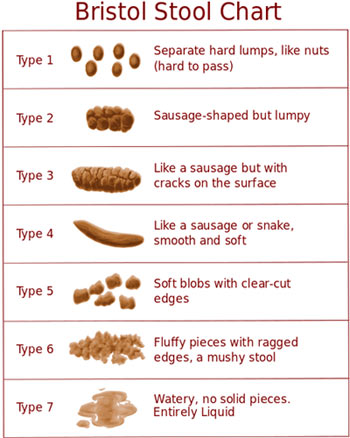
Kyle Thompson derivative work: Jpb1301 [CC BY-SA 2.5-2.0-1.0 (http://creativecommons.org/licenses/by-sa/2.5-2.0-1.0), GFDL (www.gnu.org/copyleft/fdl.html) or CC-BY-SA-3.0 (http://creativecommons.org/licenses/by-sa/3.0/)], via Wikimedia Commons